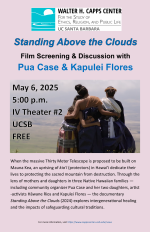
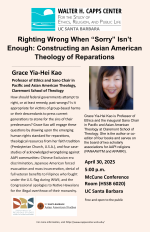
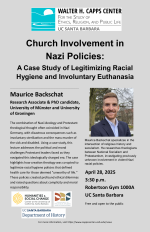
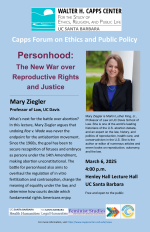
Wednesday, April 17, 2013 / 8:00 p.m.
Walter H. Capps Center for the Study of Ethics, Religion, and Public Life at UCSB
Eboo Patel
“Sacred Ground: Pluralism, Prejudice, and the Promise of America”
UCSB Corwin Pavilion – A FREE event –
Description:
More than a decade after the attacks of 9/11, suspicion and animosity toward American Muslims have still not subsided. In Sacred Ground, author and renowned interfaith leader Eboo Patel argues that such prejudice represents not just a problem for Muslims, but a challenge to the very idea of America. Patel illustrates how the forces of pluralism in America have time and again defeated the forces of prejudice. He then asks us to share in his vision of a better America—a robustly pluralistic country in which our commonalities are more important than our differences, and in which difference enriches, rather than threatens, our religious traditions.
Speaker Profile:
Named by US News & World Report as one of America’s Best Leaders of 2009, Eboo Patel is the Founder and President of Interfaith Youth Core (IFYC), a Chicago-based organization building the interfaith movement on college campuses. Author of the book Acts of Faith: The Story of an American Muslim, the Struggle for the Soul of a Generation, which won the Louisville Grawemeyer Award in Religion, and his latest book Sacred Ground: Pluralism, Prejudice, and the Promise of America, Eboo is also a regular contributor to the Washington Post, USA Today, Huffington Post, NPR, and CNN. He served on President Obama’s inaugural Advisory Council of the White House Office of Faith-based and Neighborhood Partnerships and holds a doctorate in the sociology of religion from Oxford University, where he studied on a Rhodes scholarship.
Eboo serves on the Religious Advisory Committee of the Council on Foreign Relations, on the Board of the Chicago Council on Global Affairs, on the National Committee of the Aga Khan Foundation USA, and on the Department of Homeland Security’s Faith-based Advisory Council. He has spoken at the TED Conference, the Clinton Global Initiative, the Nobel Peace Prize Forum and universities around the world. Eboo is a Young Global Leader in the World Economic Forum and an Ashoka Fellow, part of a select group of social entrepreneurs whose ideas are changing the world. He was named by Islamica Magazine as one of ten young Muslim visionaries shaping Islam in America and was chosen by Harvard’s Kennedy School Review as one of five future policy leaders to watch. Both Eboo and IFYC were honored with the Roosevelt Institute’s Freedom of Worship Medal in 2009 and Eboo was recently awarded the Guru Nanak Interfaith Prize, an award given to an individual to enhance awareness of the crucial role of religious dialogue in the pursuit of peace.
Reviews of Sacred Ground: Pluralism, Prejudice, and the Promise of America
“Eboo Patel is a remarkable young man with the wisdom to seek truth and the courage to speak it. One of America’s foremost advocates and practitioners of interfaith understanding, he has written a book that combines timely social commentary with compelling history and a wealth of personal anecdotes. Sacred Ground is a refreshing, thought-provoking, myth-smashing, and deeply patriotic exploration of American identity and ideals.” — Former Secretary of State Madeleine Albright
“Sacred Ground is simultaneously a chronicle of religious tensions in post-9/11 America and an account of how to create, through trial and error and critical self-reflection, the most successful interfaith movement in the country. Patel probes like a professor, inspires like a preacher, and writes like a poet. I really loved this book; it is a tale that is truly hard to put down.” — Robert D. Putnam, author of American Grace
“Interfaith cooperation is one of America’s founding ideals. It still sets us apart from much of the world. Eboo Patel has lived that value and, in this book, spreads that good word. Uplifting and invaluable, Sacred Ground is essential reading for our polarized era.” — Walter Isaacson, author of Steve Jobs and Benjamin Franklin
Past Events – Winter 2013
Wednesday, February 20, 2013 / 8:00 p.m.
Walter H. Capps Center for the Study of Ethics, Religion, and Public Life at UCSB
Stefan Timmermans,
“Saving Babies? The Consequences of Newborn Genetic Screening”
1104 Harold Frank Hall – A FREE event –
Description:
It has been close to six decades since Watson and Crick discovered the structure of DNA and more than ten years since the human genome was decoded. Today, through the collection and analysis of a small blood sample, every baby born in the United States is screened for more than fifty genetic disorders. Though the early detection of these abnormalities can potentially save lives, the test also has a high percentage of false positives—inaccurate results that can take a brutal emotional toll on parents before they are corrected. Now some doctors are questioning whether the benefits of these screenings outweigh the stress and pain they sometimes produce. In Saving Babies?, Stefan Timmermans and Mara Buchbinder evaluate the consequences and benefits of state-mandated newborn screening—and the larger policy questions they raise about the inherent inequalities in American medical care that limit the effectiveness of this potentially lifesaving technology.
Speaker Profile:
Stefan Timmermans is chair and professor of the sociology department at UCLA. His research draws from medical sociology and science studies and uses ethnographic and historical methods to address key issues in the for-profit U.S. health care system. He has conducted research on medical technologies, health professions, death and dying, and population health. He is currently working on an ethnographic study of the expansion of newborn screening.
His next projects will be about the community spillover effects of lack of health insurance and whole exome sequencing. His goal is to conduct robust qualitative research that reveals the invisible benefits and costs of the U.S. health care system. He is the author of Sudden Death and the Myth of CPR (Temple 1999), The Gold Standard: The Challenge of Evidence-Based Medicine and Standardization in Health Care (Temple, 2003, with Marc Berg), and Postmortem: How Medical Examiners Explain Suspicious Deaths (Chicago, 2006). His book Saving Babies? The Consequences of Newborn Genetic Screening (with Mara Buchbinder) is forthcoming from University of Chicago Press. He is also senior editor medical sociology for the journal Social Science and Medicine.
Monday, February 4, 2013 / 8:00 p.m.
Walter H. Capps Center for the Study of Ethics, Religion, and Public Life at UCSB
Timothy Noah,
“Inequality and the 2012 Election”
Lobero Theater, 33 East Canon Perdido St., Santa Barbara – A FREE event –
Description:
The 2012 presidential election was the first, since the income-inequality trend began three decades ago, to address this troubling divergence. But the discussion’s main function was to demonize Mitt Romney rather than to produce concrete solutions to the problem. Courtesy of The Book Den, copies of The Great Divergence: America’s Growing Inequality Crisis And What We Can Do About It were available for purchase and signing at this event..
Speaker Profile:
Timothy Noah is a senior editor at The New Republic, where he writes the TRB column. He was for a dozen years a senior writer at Slate, where he wrote the “Chatterbox” column, among other duties. Prior to that he was a Washington-based reporter for the Wall Street Journal, an assistant managing editor for U.S. News & World Report, a congressional correspondent for Newsweek, and an editor of the Washington Monthly (where he remains a contributing editor). Noah has written for a variety of other national publications, including the New York Times, the Washington Post, Harper’s, and Fortune. He received the 2011 Hillman Prize for a 10-part Slate series on income inequality in the U.S. that he subsequently expanded into his 2012 book, The Great Divergence: America’s Growing Inequality Crisis And What We Can Do About It.
Wednesday, January 30, 2013 / 7:00 p.m.
Walter H. Capps Center for the Study of Ethics, Religion, and Public Life at UCSB
Theater of War
Marjorie Luke Theatre – A FREE event –
AND
Thursday, January 31, 2013 / 4:00 p.m.
Walter H. Capps Center for the Study of Ethics, Religion, and Public Life at UCSB
Theater of War
Hatlen Theater – A FREE event –
Description:
“Theater of War” is an innovative public health project that presents readings of ancient Greek plays, Sophocles’ Ajax and Philoctetes, as a catalyst for town hall discussions about the challenges faced by service members, veterans, their families, caregivers and communities. This event is intended to increase awareness of post-deployment psychological health issues, disseminate information regarding available resources, and foster greater family and troop resilience. Using Sophocles’ plays to forge a common vocabulary for openly discussing the impact of war on individuals, families and communities, these events will be aimed at generating compassion and understanding between diverse audiences. Each performance includes a town hall-style audience discussion, which is facilitated with the help of military community members.
Tuesday, January 9, 2013 / 4:00 p.m.
Walter H. Capps Center for the Study of Ethics, Religion, and Public Life at UCSB
Terror’s Aftermath: New Developments in America and the Middle East
McCune Conference Room, 6020 Humanities & Social Sciences Building, UCSB – A FREE event –
Description:
This panel discussion featuring Juan Campo (Department of Religious Studies, UCSB), Richard Hecht (Department of Religious Studies, UCSB), Kathleen Moore (Department of Religious Studies, UCSB), and Salim Yaqub (Department of History, UCSB) will be moderated byWade Clark Roof (Director, Walter H. Capps Center for the Study of Ethics, Religion and Public Life and Department of Religious Studies, UCSB)
Walter H. Capps Center for the Study of Ethics, Religion, and Public Life at UCSB
UCSB Interdisciplinary Humanities Center series Fallout: In the Aftermath of War
Past Events – Fall 2012
Sunday, November 18, 2012 / 3:00 p.m.
Walter H. Capps Center for the Study of Ethics, Religion, and Public Life at UCSB
Vivek Wadhwa and Ahmed Zewail,
“Technology’s Promise, Humanity’s Future” “
UCSB Campbell Hall – A FREE event –
As late as the mid-twentieth century science and technology were celebrated as instruments of progress, but by the early twenty-first century they were viewed as threats to life on earth. How may science and technology be managed to advance humanity?
Vivek Wadhwa is Vice President of Academics and Innovation at Singularity University, Fellow at the Arthur & Toni Rembe Rock Center for Corporate Governance, Stanford University, Director of Research at the Center for Entrepreneurship and Research Commercialization at the Pratt School of Engineering, Duke University, and distinguished visiting scholar, Halle Institute of Global Learning, Emory University. In 2012, the U.S. Government awarded Wadhwa distinguished recognition as an “Outstanding American by Choice” — for his “commitment to this country and to the common civic values that unite us as Americans.”
Wadhwa oversees the academic programs at Singularity University, which educates a select group of leaders about the exponentially growing technologies that are soon going to change our world. These advances—in fields such as robotics, A.I., computing, synthetic biology, 3D printing, medicine, and nanomaterials—are making it possible for small teams to do what was once possible only for governments and large corporations to do: solve the grand challenges in education, water, food, shelter, health, and security.
In his roles at Stanford, Duke, and Emory universities, Wadhwa lectures in class on subjects such as entrepreneurship and public policy, helps prepare students for the real world, and leads groundbreaking research projects. He is an advisor to several governments; mentors entrepreneurs; and is a regular columnist for The Washington Post, Bloomberg BusinessWeek, and the American Society of Engineering Education’s Prism magazine. Prior to joining academia in 2005, Wadhwa founded two software companies.
Ahmed Zewail, winner of the 1999 Nobel Prize in Chemistry, serves as Linus Pauling Professor of Chemical Physics and Professor of Physics at the California Institute of Technology, (Caltech), where he is currently the Director of the Moore Foundation’s Center for Physical Biology. In 2009, President Barack Obama appointed him to the President’s Council of Advisors of the White House and named him as the first United States Science Envoy to the Middle East. In 2011, he was recognized as one of the Top American Leaders of the year by The Washington Post and Harvard Kennedy School’s Center for Public Leadership.
Dr. Zewail was the sole recipient of the 1999 Nobel Prize for his pioneering developments in femtoscience, making possible observations of atomic motions during molecular transformations in femtosecond, a millionth of a billionth of a second. More recently, he and his group have developed the field of 4D electron microscopy for the direct visualization of matter’s behavior, from atoms to biological cells, in the four dimensions of space and time. A significant effort is also devoted to giving public lectures on science and on the promotion of education and partnership for world peace, and he continues to serve on national and international boards for academic, cultural, and world affairs.
For his contributions to science and public life he has garnered other honors from around the globe: forty honorary degrees in the sciences, arts, philosophy, law, medicine, and humane letters from universities around the world; orders of state and merit; commemorative postage stamps; and more than one hundred international awards, including the Albert Einstein World Award of Science, Benjamin Franklin Medal, the Robert A. Welch Award, the Leonardo da Vinci Award, the King Faisal International Prize, and the Priestley Medal.
In his name, international prizes have been established, and the AZ foundation provides support for the dissemination of knowledge and for merit awards in arts and sciences.
This free, public event is part of the Hamdani World Harmony Lecture Series and is presented by the Walter H. Capps Center for the Study of Ethics, Religion, and Public Life at UCSB.
Wednesday, October 10, 2012 / 8:00 p.m.
Walter H. Capps Center for the Study of Ethics, Religion, and Public Life at UCSB
Mickey Edwards,
“It’s Time to Turn Republicans and Democrats Into Americans”
Lobero Theatre, 33 East Canon Perdido Street, Santa Barbara – A FREE event –

American government has become dysfunctional but that’s not just because we elect the wrong people; it’s because we’ve created a political system that rewards intransigence and incivility and punishes cooperation and compromise. We’ve allowed political parties to manipulate our elections and even our governing systems for their own partisan advantage. To fix the problem and get government working again, we have to change the political system itself. Courtesy of The Book Den, copes of The Parties Versus the People will be available for purchase and signing at this event.
Former Congressman Mickey Edwards is a lecturer at Princeton University’s Woodrow Wilson School of Public and International Affairs. He is also a vice president of the Aspen Institute and director of the Institute’s Aspen-Rodel Fellowships in Public Leadership program.
Edwards served as a member of Congress for 16 years, during which time he was a senior member of the House Republican leadership as chairman of the Republican Policy Committee, a member of both the House Appropriations and Budget committees, and ranking member of the House Subcommittee on Foreign Operations. After leaving Congress, he taught government and public policy at Harvard’s Kennedy School of Government for 11 years before moving to Princeton in 2004. He has taught at Harvard Law School and as a visiting professor at Georgetown University’s Public Policy Institute.
Edwards has been a regular columnist for a number of newspapers, including the Chicago Tribune, the Los Angeles Times, the San Francisco Examiner, and the Boston Globe, and for years broadcasted weekly political commentary on National Public Radio’s “All Things Considered.” His articles have also appeared frequently in The New York Times, the Wall Street Journal, The Washington Post, the San Francisco Examiner, the Miami Herald, the St. Louis Post-Dispatch, the Boston Herald, the Tulsa World and other major newspapers, and in such publications as The National Interest, The Public Interest, and Policy Review. He is the author of two books, the co-author of a third, and he has contributed chapters to several more. His latest book is “The Parties Versus the People: How to Turn Republicans and Democrats into Americans” (August, 2012).
Edwards has chaired task forces on foreign policy for The Brookings Institution and the Council on Foreign Relations and is a director of several organizations in the fields of public policy and foreign affairs, including The Constitution Project. He has also been an adviser to the State Department. Edwards has degrees in both journalism and law.
This event is presented by the Walter H. Capps Center for the Study of Ethics, Religion, and Public Life at UCSB.
Monday, October 1, 2012 / 8:00 p.m.
Walter H. Capps Center for the Study of Ethics, Religion, and Public Life at UCSB
Jonathan Alter,
“Why the 2012 Election Is the Most Pivotal of Our Lifetime”
Lobero Theatre, 33 East Canon Perdido Street, Santa Barbara – A FREE event –
The question this year is whether the country will stay on a centrist course or make a sharp turn to the right. If President Obama is reelected, the federal government will continue to take responsibility for lending a helping hand to people in need. If Mitt Romney wins, the safety net will be shredded. Because few votes may be won by discussing the poor, the American social contract is rarely discussed. But it is on the line.
Jonathan Alter is the author of two New York Times best-sellers, The Promise: President Obama, Year One and The Defining Moment: FDR’s Hundred Days and the Triumph of Hope and a weekly columnist for Bloomberg View.
Before Bloomberg View, Alter spent 28 years as a correspondent, editor and columnist for Newsweek where he covered seven presidential elections and authored more than 50 cover stories.
Presented by the Walter H. Capps Center for the Study of Ethics, Religion, and Public Life at UCSB.


By PDGACO payday loans uk